If you run a warehouse, factory, or logistics operation in Pakistan — and your forklifts run on lead-acid batteries — chances are you have accepted a set of daily inefficiencies as simply “the way things work”: the morning charge check, the mid-shift slowdown as voltage drops, the weekly watering routine, the battery room with its acid smell and ventilation requirements, and the looming replacement cost every three or four years.
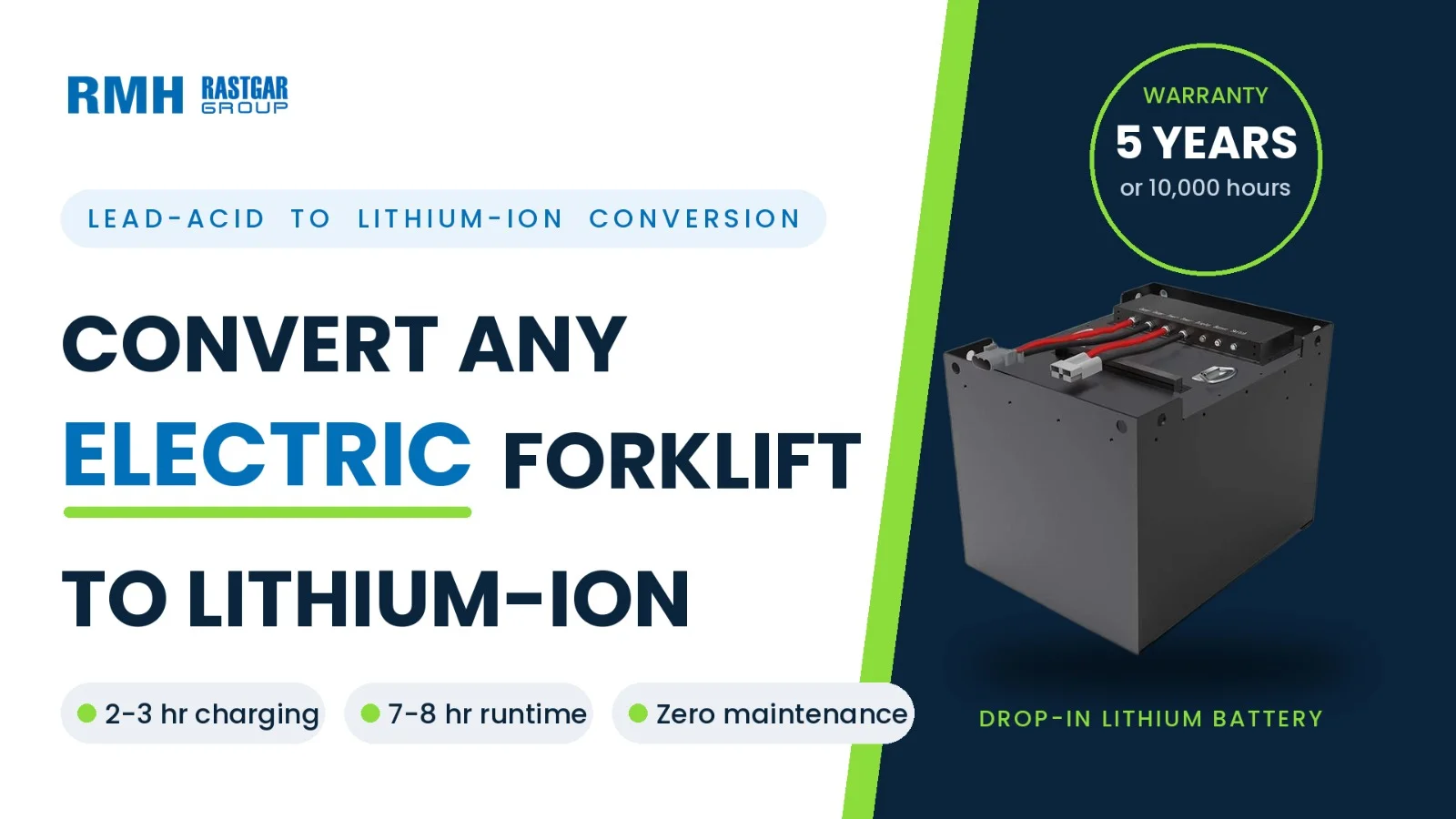
None of this is necessary anymore. Lithium-ion technology has matured, the hardware is now sourced globally at competitive prices, and RMH now offers a complete lead-acid to lithium-ion conversion — a drop-in battery custom-designed to fit your existing electric forklift exactly as it stands, no machine modifications required.
This article walks through the real operational impact, the economics, how the conversion process works, and what to expect from the warranty.
The Hidden Cost of Lead-Acid Batteries
Lead-acid batteries are cheap to buy. That is almost always the only number that enters a procurement decision. But the purchase price is a small fraction of what a lead-acid battery actually costs over its lifetime — and most operations never add it all up.
1. Charging time kills productivity
A lead-acid battery requires 8 to 10 hours to charge, followed by a mandatory cool-down period before it can be used again. For single-shift operations this is manageable. For anything running extended hours — two shifts, a busy peak season, or time-sensitive logistics — it means either buying extra batteries to rotate, building a dedicated battery room, or accepting that your machines sit idle.
2. Voltage sag costs you at the worst time
Lead-acid batteries do not deliver consistent power across their charge cycle. In the final 20–30% of charge, voltage drops noticeably — lift speeds slow, travel is sluggish, and operator productivity falls precisely when the machine is needed most. Lithium-ion batteries deliver consistent, flat-curve power output from full charge to nearly empty.
3. Maintenance is a hidden labour cost
Lead-acid batteries require weekly electrolyte top-ups (watering), equalisation charges, terminal cleaning, and acid-level checks. This work requires trained personnel, protective equipment, and careful scheduling. It is a recurring overhead that rarely appears in a battery cost calculation — but it is always there.
4. Battery rooms are a capital and compliance cost
Proper lead-acid battery charging requires a ventilated, acid-resistant charging area — both for safety and to meet workplace standards. Building and maintaining this space, often with eyewash stations and acid-resistant flooring, is a real capital cost that a lithium conversion eliminates entirely.
5. Replacement cycles add up
A well-maintained lead-acid battery lasts approximately 1,500 charge cycles — roughly three to four years at typical usage. At that point, the battery must be replaced entirely. Lithium-ion batteries are rated for 3,000 cycles or more, effectively doubling the replacement interval.
Lead-Acid vs. Lithium-Ion: The Numbers Side by Side
| Parameter | Lead-Acid | Lithium-Ion (RMH) |
| Charging time | 8–10 hrs + cool-down | 2–3 hrs, charge in breaks |
| Running time | 5–6 hrs per charge | 7–8 hrs running / operations |
| Maintenance | Weekly watering & acid | Zero maintenance |
| Battery life | ~1,500 cycles | 3,000 cycles |
| Battery room | Required | Not required |
| 5-year total cost | Baseline | Up to 47% lower |
What “Drop-In Replacement” Actually Means
The term “drop-in” is important. RMH does not modify your forklift. We do not retrofit the charger circuit, alter the battery compartment, or change anything about how the machine operates. Instead, we design a lithium-ion battery pack that matches your existing battery’s physical dimensions, voltage, and connector type — so it slots directly into the battery compartment your machine already has.
How the custom design works
You share the dimensions, voltage, and capacity from your existing battery’s nameplate — along with a WhatsApp photo of the battery compartment. Our team uses that information to design a lithium pack that fits precisely into your machine. There is no guesswork, no trial-fit, and no modifications to your forklift.
This matters for a Pakistani fleet context specifically: we can convert any electric forklift, any brand — Hyundai, Toyota, Crown, Yale, Linde, Hangcha, or any other make operating in Pakistan — because the design is built to the machine, not sourced off a generic shelf.
The Conversion Process: What to Expect
Initial assessment (free)
Call or WhatsApp RMH at +92 334 5933391. Share your forklift make, model, existing battery dimensions (L × W × H), voltage, and capacity (Ah) — all readable from the battery nameplate. A photo via WhatsApp is ideal.
Custom battery specification
RMH engineers design a lithium-ion battery pack matched exactly to your machine’s compartment size, voltage requirement, and connector type. The specification is shared with you for review before production.
Production and delivery
The battery is manufactured to specification and delivered to your site. Lead time is discussed at the quotation stage and depends on specification complexity and quantity.
Drop-in installation
The old lead-acid battery is removed. The new lithium-ion pack is placed into the existing compartment and connected. No machine modification. Your forklift is ready to run.
Warranty activation
Warranty begins from the date of delivery: 5 years or 10,000 running hours, whichever comes first (3,000 charge cycles).
The Warranty
5 Years or 10,000 Running Hours
Warranty is from the date of delivery, whichever comes first — with 3,000 charge cycles. This is a manufacturer-backed commitment on the battery cell and BMS (Battery Management System), covering defects in materials and workmanship under normal operating conditions.
Is This the Right Upgrade for Your Operation?
The lithium conversion makes the most economic sense for operations with:
- Multi-shift or extended-hour usage — where charging downtime actively constrains throughput.
- Fleet size of 2 or more electric forklifts — where the aggregate savings on maintenance and battery rooms are significant.
- Lead-acid batteries nearing end of life — where replacement is already due and the incremental cost of going lithium rather than replacing like-for-like is modest.
- Operations concerned about downtime — lithium’s fast charging (2–3 hrs during a break) eliminates the “we only have one battery and it needs overnight charging” constraint entirely.
If your forklifts run diesel or LPG rather than on batteries, this conversion is not applicable — the service is specifically for electric forklifts currently running lead-acid batteries.
About RMH — Rastgar Materials Handling
RMH is a brand of the Rastgar Group, in business since 1980, specialising in material handling equipment for Pakistan’s industrial sector. Our customers include some of Pakistan’s largest warehouse, manufacturing, and logistics operations. The lithium-ion battery conversion service is a new offering designed to help existing electric forklift fleets get more out of the equipment they already own.
