The Silent Crisis Inside Pakistan’s Warehouses
Walk into any large warehouse in Karachi’s SITE area, Port Qasim, or Lahore’s industrial estates and you will notice the same thing: wide, empty aisles eating up space that nobody is paying rent for.
Those aisles are not empty by design. They exist because the forklifts inside them demand it. A conventional counterbalance forklift needs 3.5 to 4.5 metres of clear aisle width just to turn, pick, and travel safely. In a city where industrial land now sells for tens of millions of rupees per kanal — and where every square foot of warehouse space directly translates into rent, rates, and operating cost — those wide aisles are one of the most expensive things a business owns.
The problem is getting worse. Pakistan’s logistics and FMCG sectors are growing rapidly. E-commerce has added pressure on last-mile fulfilment centres. Cold-chain facilities are expanding. Yet the availability of affordable industrial land — particularly in Karachi, Lahore, and Faisalabad — is shrinking. Businesses are being forced to either pay more for the same space, build vertically at enormous cost, or relocate further from their customer base.
There is, however, a fourth option that most warehouse managers in Pakistan have not yet fully explored: use the space you already have — just use it smarter.
That is exactly what Very Narrow Aisle (VNA) trucks make possible.
What Is a VNA Truck?
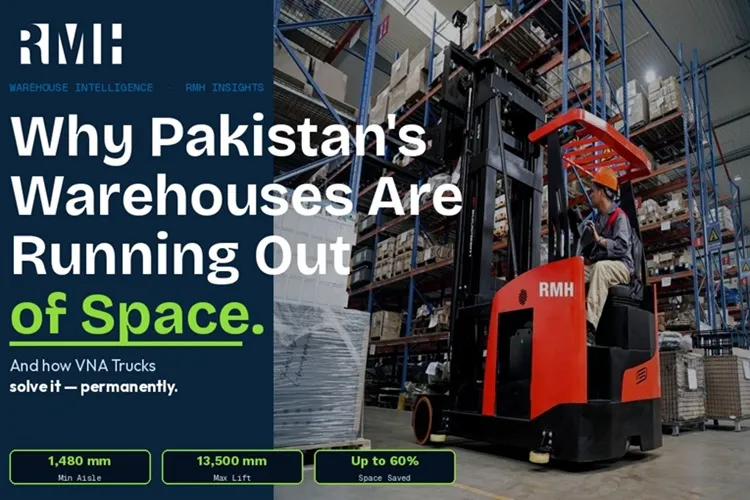
A VNA truck — Very Narrow Aisle truck — is a specialised warehouse forklift engineered to operate in aisles as narrow as 1,480 mm (approximately 4 feet 10 inches). By comparison, a conventional forklift requires aisles of 3,500 mm or more.
This difference sounds technical. The business impact is anything but.
When you halve your aisle width, you do not just save a metre of floor space here and there. You fundamentally change the geometry of your entire warehouse. More racks can be installed in the same footprint. Storage density increases dramatically. The same building that held 1,000 pallet positions with conventional forklifts can hold 1,400, 1,600, or even 1,800 positions with VNA — without laying a single new brick.
VNA trucks achieve this through a combination of engineering features that conventional forklifts simply do not have:
- Rotating forksthat can pick and deposit loads sideways without the truck itself turning — meaning the truck travels straight down the aisle and reaches racking on both sides
- Magnetic or wire guidanceembedded in the floor that keeps the truck perfectly centred in the aisle at all times, eliminating the risk of rack strikes
- Man-Up or Man-Down operator cabinsthat rise with the forks, giving the operator clear, close-up visibility at heights of up to 13,500 mm
- Lithium-Ion battery powerthat delivers consistent, all-shift performance without the need for a battery-changing room, acid maintenance, or mid-shift battery swaps

Karachi’s Space Problem: By the Numbers
Karachi is Pakistan’s commercial capital and the country’s busiest logistics hub. It processes the majority of Pakistan’s imports and exports through Port Qasim and Karachi Port. It is home to hundreds of FMCG manufacturers, pharmaceutical companies, textile exporters, and retail distribution centres.
It is also one of the most land-constrained industrial cities in South Asia.
Industrial land in prime Karachi locations — SITE, Korangi, Landhi, North Karachi — has seen values multiply several times over the past decade. Monthly rental rates for warehousing space in well-connected areas now regularly exceed PKR 60 to 100 per square foot. A mid-size warehouse of 20,000 square feet can cost a business PKR 1.2 to 2.0 million per month in rent alone, before utilities, staffing, or security.
Against this backdrop, every square foot of aisle space that is not being used for storage is costing real money every single day.
Consider a practical example. A warehouse currently operating with conventional forklifts across 15,000 square feet might dedicate 35 to 40 percent of that floor area to forklift aisles — roughly 5,250 to 6,000 square feet of space storing nothing but air. At PKR 80 per square foot per month, that is PKR 420,000 to 480,000 in monthly rent being paid for empty aisles.
Converting to VNA operations could reduce aisle space to 20 percent or less, recovering 2,000 to 3,000 square feet of productive storage area. That is space that either saves rent costs or enables the business to grow its inventory capacity without signing a new lease.

The Myth That VNA Is Only for Large Operations
One of the most common misconceptions RMH encounters is the belief that VNA technology is only relevant for large multinational corporations or massive third-party logistics providers.
This is no longer true.
Modern VNA trucks — including those supplied by RMH through Hyundai Material Handling — are available in load capacities starting from 1.2 tonnes, making them suitable for a wide range of operations: mid-size FMCG distributors, pharmaceutical warehouses, retail DC operations, textile exporters, and industrial spare parts stores.
The economics have also become significantly more favourable with the shift to Lithium-Ion battery technology. Earlier generations of VNA trucks required significant infrastructure investment: battery charging rooms, acid management, ventilation systems, and dedicated charging equipment. Lithium-Ion eliminates most of that. A modern VNA truck can be opportunity-charged during breaks, delivers consistent power throughout the shift, and requires virtually zero battery maintenance over a lifespan of 3,000 or more charge cycles.
For a medium-size Pakistani business spending PKR 1 to 2 million per month on warehouse rent, the return on investment from a VNA conversion can be compelling — particularly when the alternative is signing a new, larger, and more expensive lease.
How VNA Works in Practice: A Day in the Aisle
To understand why VNA trucks are so effective, it helps to see how a typical VNA operation works.
The warehouse is laid out with racking running in long parallel rows. Steel rails or magnetic strips are embedded in the concrete floor of each aisle during installation. When the VNA truck enters an aisle, its guidance system engages automatically — the truck is now on a fixed, perfectly straight path centred between the racks.
The operator uses the rotating fork mechanism to pick or place loads on either side without ever turning the truck. The forks swing left or right, extend, and retract while the truck remains stationary in the aisle. This means the aisle only needs to be wide enough for the truck body itself — approximately 1,200 to 1,300 mm — plus a small safety clearance on each side.
When the operator has completed picking or put-away in that aisle, the truck exits, the guidance system disengages, and the truck travels at normal speed across the open floor to the next aisle or to the loading area.
The entire system is designed for high-throughput, repetitive operation in dense storage environments. Experienced VNA operators working in well-designed warehouses can achieve pick rates that rival or exceed conventional forklift operations — while using a fraction of the floor space.
Sectors in Pakistan That Benefit Most
Based on RMH’s experience working across Pakistan’s industrial base since 1980, the following sectors stand to gain the most from VNA adoption:
FMCG and Consumer Goods
High SKU counts, fast inventory turnover, and the need to store significant stock in proximity to distribution routes make FMCG warehouses ideal VNA candidates. Companies like those distributing packaged foods, household products, and beverages often have hundreds of product lines requiring dedicated racking slots.
Pharmaceuticals and Healthcare
Strict inventory control, temperature management, and the need to minimise product handling make high-density, guided storage highly attractive. VNA allows pharmaceutical distributors to maintain large SKU ranges in compact, climate-controlled spaces.
Retail and E-Commerce Fulfilment
As Pakistani e-commerce grows, fulfilment centres face pressure to store more SKUs in less space while enabling fast picking. VNA systems, particularly Man-Up configurations, excel in this environment.
Textiles and Apparel
Fabric rolls, finished goods, and seasonal stock create significant storage density challenges. VNA racking systems allow textile businesses to stack high and manage inventory more effectively.
Industrial and Engineering
Spare parts, components, and MRO (Maintenance, Repair, and Operations) inventory are often stored in sprawling, inefficient layouts. VNA brings order and density to these operations.
The RMH Approach: Not Just a Truck Sale
At RMH, we do not simply supply a forklift and walk away. A VNA implementation is a warehouse transformation project, and we approach it that way.
Our process begins with a free warehouse space assessment — a detailed analysis of your current storage layout, forklift operations, inventory volumes, and throughput requirements. From this assessment, we model what a VNA configuration would look like in your specific building, including projected storage capacity gains, aisle configurations, racking specifications, and guidance system requirements.
We then work with your team through installation, commissioning, and operator training — ensuring that the investment delivers its full return from day one.
Our after-sales commitment covers the full lifecycle of the equipment:
- Spare partsstocked locally, available rapidly
- Preventive maintenanceprogrammes to protect uptime
- Operator trainingfor fork lift safety, VNA-specific technique, and efficiency
- Warranty supportcoordinated through our nationwide service network
This is what RMH’s 4-S commitment means in practice: Sales, Service, Spares, and Solutions — not as a tagline, but as the four pillars of every customer relationship we build.
What Maqsood Zulfqar, CEO of RMH, Says
“The biggest benefit of VNA is space saving. With a normal forklift, you have to place racks far apart — wide aisles, wasted space. With VNA, the racks come closer together, the aisles get narrower, and suddenly you have far more storage in the same building. In Karachi especially, space is a very serious issue. Land is expensive. Rent is expensive. VNA is not just a forklift — it is a solution to one of the most real cost problems our customers face every day.”
— Maqsood Zulfqar, CEO, Rastgar Materials Handling
Making the Decision: Is VNA Right for Your Warehouse?
VNA is not the right solution for every operation. It works best when certain conditions are met:
- Your warehouse has racking or racking is being planned
- Aisle width is currently a constraint on storage capacity
- Your operations involve repetitive picking or put-away rather than bulk floor stacking
- You are paying significant rent per square foot and need to maximise every metre
- Your SKU range requires organised, location-based inventory management
- You are open to floor guidance installation as part of a one-time setup
If these conditions describe your operation — or if you are planning a new warehouse and want to design it for maximum efficiency from the start — a VNA assessment is a conversation worth having.
Take the Next Step
RMH has been helping Pakistan’s industries handle materials more efficiently since 1980. Our team includes engineers, solutions consultants, and after-sales specialists who understand the specific challenges of operating warehouses in Karachi, Lahore, Faisalabad, and beyond.
We offer a free, no-obligation warehouse space assessment to help you understand exactly what VNA could deliver for your operation — in square feet recovered, pallets added, and rupees saved.
Get in touch:
- 📞 +92 334 5933391 | +92 344 4437099
- 📧 info@rmh.com.pk
- 🌐 www.rmh.com.pk
- 📍 Suite 902-903, 9th Floor, Tricon Corporate Centre, 73-E Jail Road, Gulberg, Lahore